

coactivator aiby

Your strategy office. Always working.

Every company in your market sees the same data. We read it against your strategy.

A retained strategy office for biopharma leadership teams. AI agents built around your plan work on your launch, access, supply and competition every day. Two former healthcare executives, with strategy consulting roots at Accenture and BCG and years in operating roles, direct that work and turn it into decisions.

An AI-powered strategy office for the cost of one senior hire.

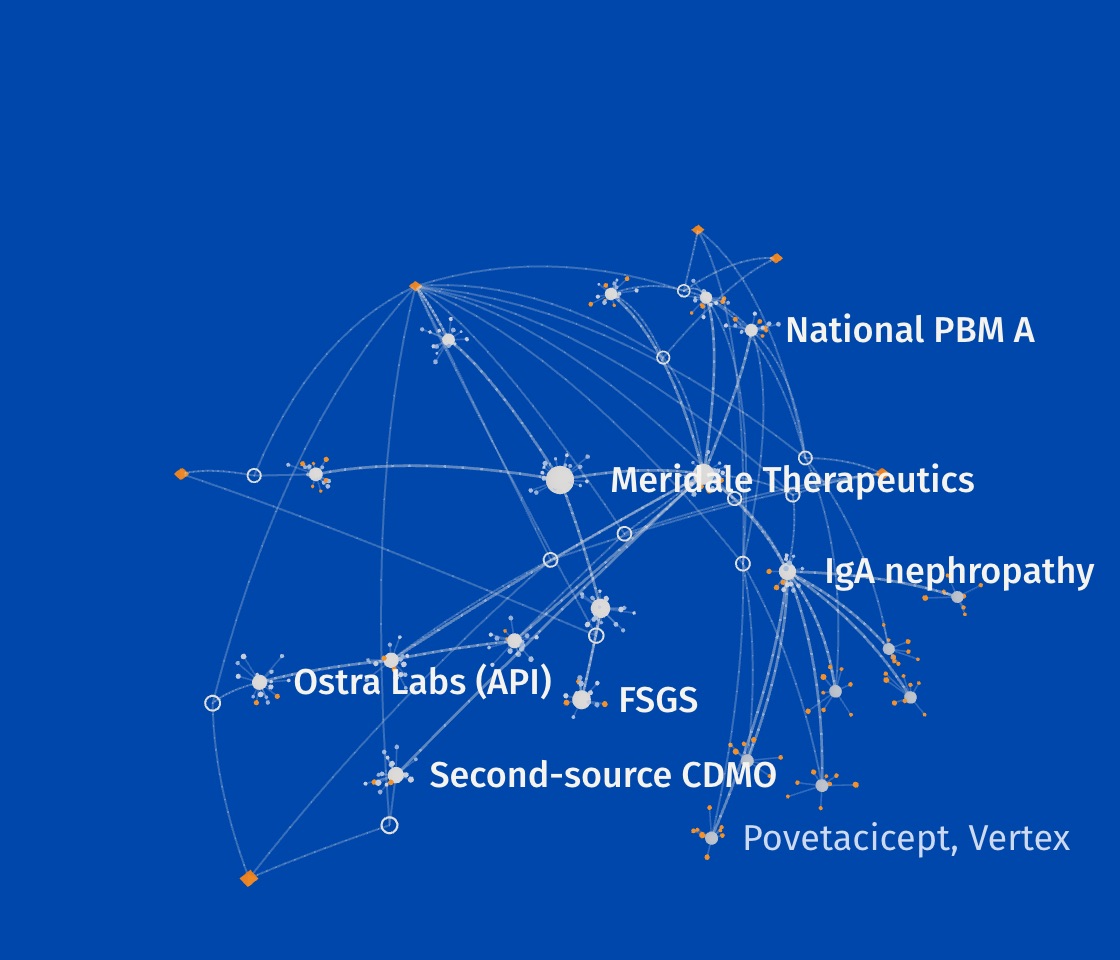
The strategy graph for Meridale Therapeutics, the illustrative company: its products, markets, competitors, suppliers and the assumptions its plan rests on.

The two people you work with

Coactivator is the two of us: former big firm strategy consultants who went on to run healthcare businesses. Our agents do the reading. We do the judgment.

Sanjay Cherian

Sanjay CherianA decade at Accenture as a strategy consultant specializing in health and life sciences, advising Merck, Pfizer and AstraZeneca on launches and marketing investment. Then an operator: Chief Product Officer at Telus Health and Global Head of Generative AI at Nike.

Hans Oh

Hans OhHans Oh is a former BCG Digital Health Expert and Team Lead who has advised pharma, providers, and payers, and served as a vice president at ZappRx and Omnicell. He founded Innoveron Group and co-founded Tenuto Labs.

More about us

How it works

Every engagement runs on two kinds of agents, built around your plan. Watch agents read public sources every day. Office agents do the work a strategy team does with what the watch agents find. Then the two of us take over: we test their work against your plan and our own experience, add the context the data does not carry, and decide what it means for you.

  1. 1

    Public sources

    FDA, CMS, payers, trial registries, state filings, bond disclosures, company filings, congresses

  2. 2

    Watch agents

    Read every day and flag what touches your plan

  3. 3

    Your strategy model

    Your assumptions and decisions, versioned

  4. 4

    Office agents

    Analysis, scenarios, options and packs

  5. 5

    Your leadership team

    Briefs, dashboards and board packs

Hans and Sanjay

Test the findings, add context from experience, and shape the recommendation

Your decisions update the model.

The agents do the reading and the first draft. We bring the judgment: which findings matter, what they mean for your plan, and what you should do next.

We use a proprietary, ontology-driven method to model your company's strategy. The ontology is a formal map of the entities in your business (assets, indications, competitors, payers, suppliers) and how they relate to each other. Everything else runs on that map.

Your strategy model. From your plans, board materials and leadership conversations, we build a versioned model of what you're betting on and what those bets assume. When an assumption changes, the model records what changed it and when. It also records the questions your leadership team and board ask, so each cycle starts from what they will want to know next.

Two kinds of agents. Watch agents read external sources continuously, with one set for each decision: FDA actions and inspection data, ClinicalTrials.gov, payer policies and formularies, CMS notices, competitor filings, earnings calls and congress abstracts. Office agents do the work a strategy team does with what the watch agents find: market research, scenarios and options, execution tracking, and board and leadership packs. Each one works from frameworks built for biopharma.

A lens for every decision. Every finding passes through the lens for the decision it bears on: launch, access, supply, competitive, capital or board. Each lens has the same structure: what happened, which part of your plan it touches, what else depends on that, what it means, the questions you will be asked, your options, our recommendation, and the sources. Each asks its own questions; the supply lens, for example, asks about CDMO exposure and inventory cover. Because the structure never changes, you can compare this quarter's findings with last quarter's, and so can your board.

Sourced and reviewed. Every statement carries its source and the date we retrieved it. Nothing reaches your leadership team until one of us has reviewed it. You receive briefs and recommendations, and we run the system behind them.

See the agents

Agent tags

  • Biopharma
  • Healthcare
  • No tag: used for both

Tagged agents are illustrative of what we build for each kind of client.

Watch agents

Read public sources continuously, one set for each decision.

  • Launch Demand Watch

    Tracks demand against your forecast, from the data you already license and public prescriber data.

    Launch lens

    Biopharma
  • Market Access and Formulary Watch

    Reads payer policies, formularies and CMS notices for anything that changes your coverage.

    Access lens

    Biopharma
  • Supply Resilience Watch

    Follows FDA inspections, warning letters and import alerts at your CDMOs and API suppliers.

    Supply lens

    Biopharma
  • Competitor Registry and Catalyst Watch

    Tracks competitor trials, label changes and PDUFA dates in your indication.

    Competitive lens

    Biopharma
  • Congress Readout Delta

    Compares what a congress abstract says with what the company said before.

    Competitive lens

    Biopharma
  • AI Drug Information Monitor

    Checks how AI assistants describe your therapy against the alternatives.

    Competitive lens

    Biopharma
  • Global Asset Scout and Diligence First Pass

    Screens in-licensing candidates and comparable deals, with a first diligence note on each.

    Capital lens

    Biopharma
  • Market Sentinel

    Reads certificate-of-need filings, licensing notices and competitor openings in your service areas.

    Growth lens

    Healthcare
  • Payer Policy and Rate Watch

    Reads commercial payers' medical and site-of-care policies, and the rates in hospital and payer price transparency files.

    Contracting lens

    Healthcare
  • CMS Rule Watch

    Reads proposed and final payment rules for hospital outpatient, inpatient and physician services, and sizes each one against your plan.

    Contracting lens

    Healthcare
  • Medicare Advantage Market Benchmarker

    Reads CMS enrollment, Star Ratings and plan landscape files for every plan in your counties.

    Health plan lens

    Healthcare
  • Workforce Market Watch

    Reads competitor job postings, wage announcements and state licensure data.

    Capacity lens

    Healthcare
  • Bond and Affiliation Watch

    Reads municipal bond disclosures, rating agency actions and affiliation announcements in your region.

    Capital lens

    Healthcare

Office agents

Turn what the watch agents find into analysis, options and packs, which we then test and finish.

  • Strategy Execution Tracker

    Tracks the plan's commitments and flags slippage before the quarterly review.

  • Indication and Policy Sequencer

    Orders launches and indications against IRA timing and MFN pricing.

    Access lens

    Biopharma
  • Scenario and Options

    Builds the options and scenarios when an assumption moves.

  • Readout Scenario Book

    Prepares your response to each possible outcome before a competitor readout.

    Competitive lens

    Biopharma
  • Portfolio Value Refresh

    Updates the value of each asset when one of its inputs changes.

    Capital lens

    Biopharma
  • Market Research

    Answers specific questions about your category from published sources.

  • Strategic Planning

    Keeps the long-range plan and the assumptions behind it current.

  • Strategy Dashboard

    Keeps the decision and assumption views for the CEO, COO and board current.

  • Board and Leadership Pack Builder

    Drafts board packs and leadership pre-reads for us to review and finish.

  • Service Line Market Assessor

    Builds the fact base behind each grow, hold or exit decision by service line.

    Growth lens

    Healthcare
  • Rate Position Analyst

    Shows where your negotiated rates sit against competitors, payer by payer.

    Contracting lens

    Healthcare
  • Bid and Stars Scenario Builder

    Models what a Star Rating or benchmark change does to benefits, membership and margin.

    Health plan lens

    Healthcare

Meridale Therapeutics is a fictional biopharma company in a real market: its competitors and their approvals are real and public. Scroll on to watch the agents read that market against Meridale's plan.

Between board meetings, the FDA posts inspection results, a competitor files an sNDA, a PBM moves a product to a non-preferred tier, and a handful of congress abstracts reframe your category. All of it is public, and most of it doesn't matter to you. The few items that do matter tend to reach your leadership team late, through an analyst note or a forwarded email.

This week, 46 FDA actions, 112 trial registry updates, 27 payer policy changes, 9 competitor filings. 3 touched your plan.

Built around the decisions you already make

A biopharma leadership team comes back to the same six decisions every quarter. We build a set of agents and a lens for each one, and they report to us.

Launch and uptake

Is demand tracking the forecast, and where it isn't, why?
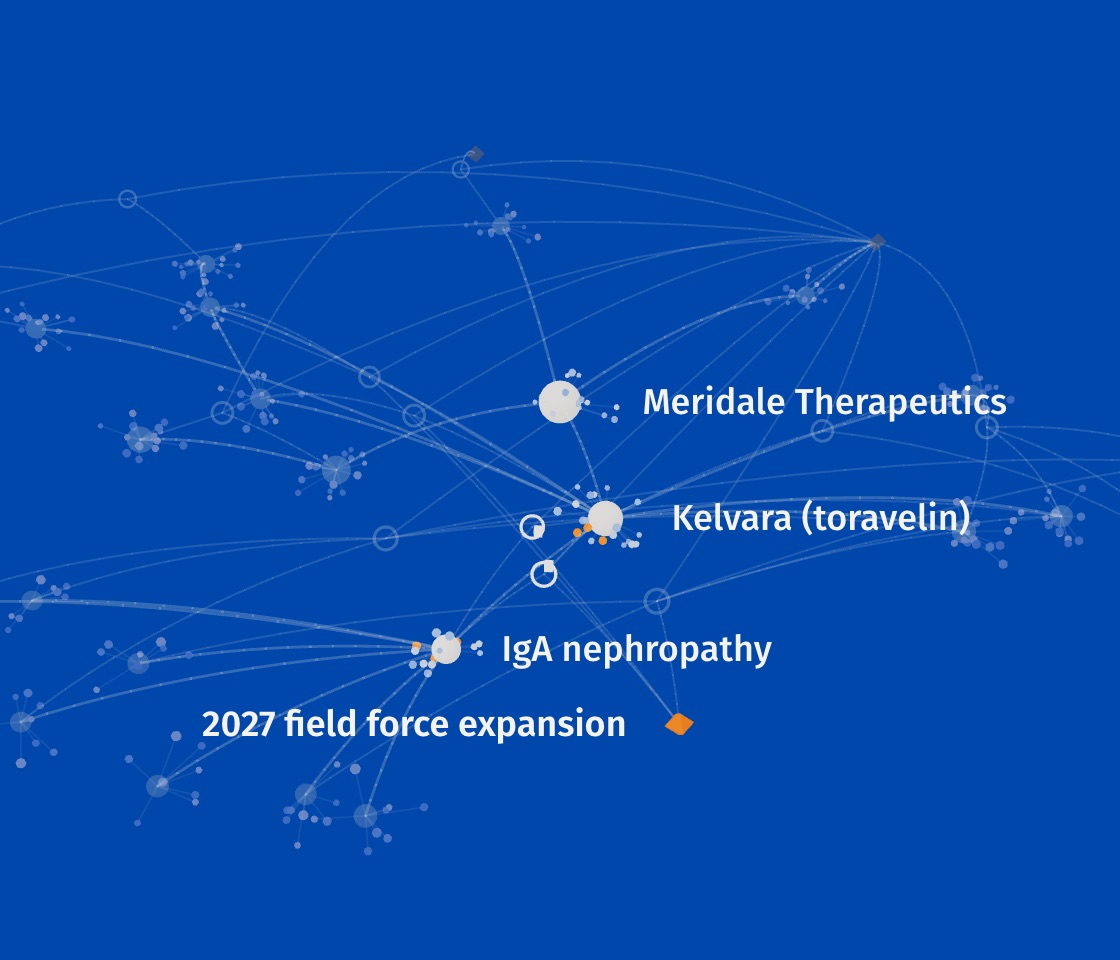
The part of Meridale's strategy graph behind the decision: Launch and uptake

Launch lens

  • Launch Demand Watch, Watch agents
  • Strategy Execution Tracker, Office agents

One example

  1. New Kelvara starts run 11% below forecast for four weeks, in two regions where hub benefit verification time has doubled
  2. Kelvara reaches 4,200 patients on therapy by Dec 2027Holding to Watch

  3. What it means: The gap is in access processing, not prescriber demand, so the case for the field force expansion stands

We start from the demand data you already license and add public sources: prescriber activity, category growth, and persistence in published data.

What the agents read

  • Demand data you already license: specialty pharmacy and hub
  • Prescriber activity in claims data
  • Persistence studies in your category

What they produce

  • Weekly demand against forecast, by region and prescriber segment
  • The reason behind each gap
  • The assumption each gap puts at risk
Access and pricing

Payer policy and formulary changes, gross-to-net movement after each contract cycle, IRA negotiation timing, and how MFN pricing affects the order of your launches outside the US.

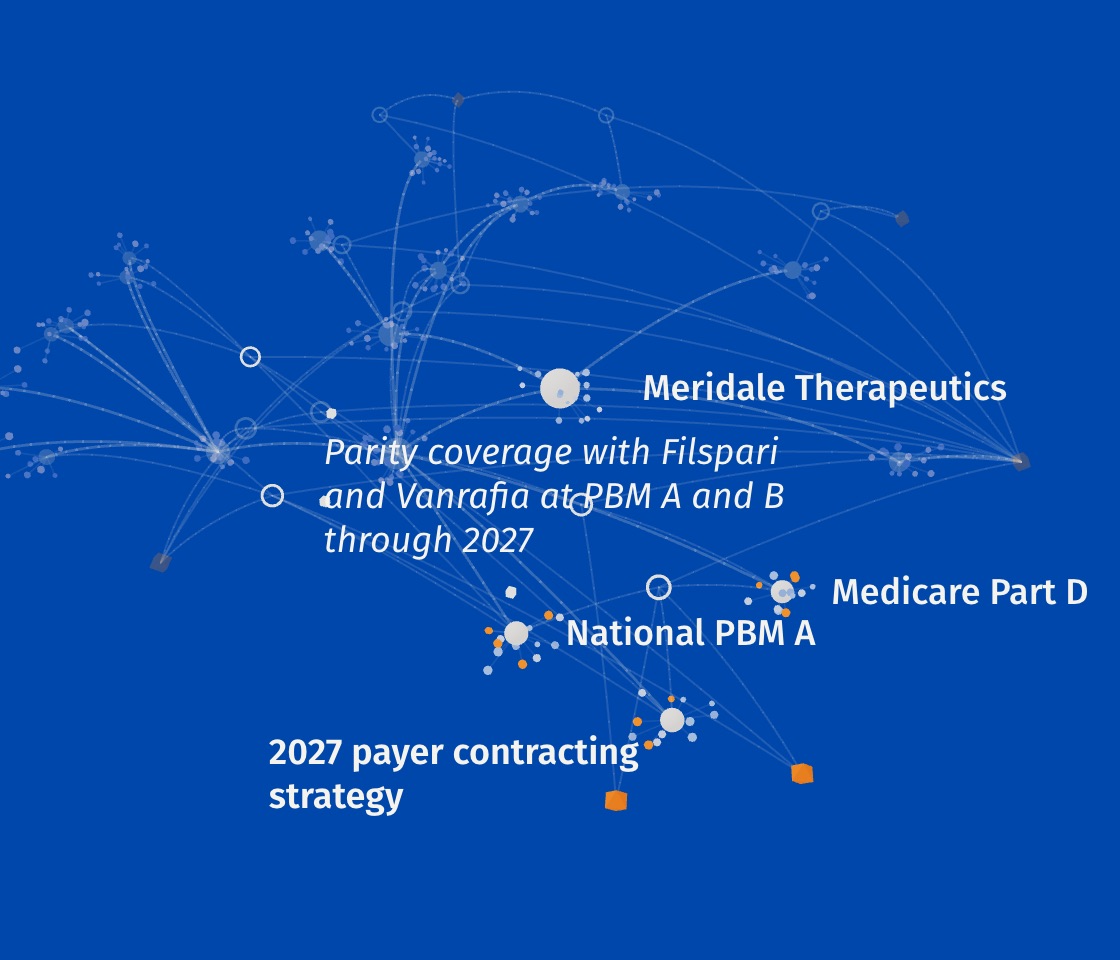
The part of Meridale's strategy graph behind the decision: Access and pricing

Access lens

  • Market Access and Formulary Watch, Watch agents
  • Indication and Policy Sequencer, Office agents
  • Scenario and Options, Office agents

One example

  1. National PBM B's 2027 formulary adds a step edit that requires an older therapy before any drug in your class
  2. Parity coverage with Filspari and Vanrafia at PBM A and B through 2027Holding to Watch

  3. What it means: The 2027 payer contracting decision gets a rebate scenario before the bid deadline

What the agents read

  • Formularies and coverage policies at the national PBMs and largest plans
  • CMS notices on Part D and IRA negotiation
  • Federal most-favored-nation pricing announcements

What they produce

  • A tier-by-tier view of where your product sits at each payer
  • A gross-to-net bridge after each contract cycle
  • A timeline of the pricing events that bear on your launch sequence

Supply and manufacturing

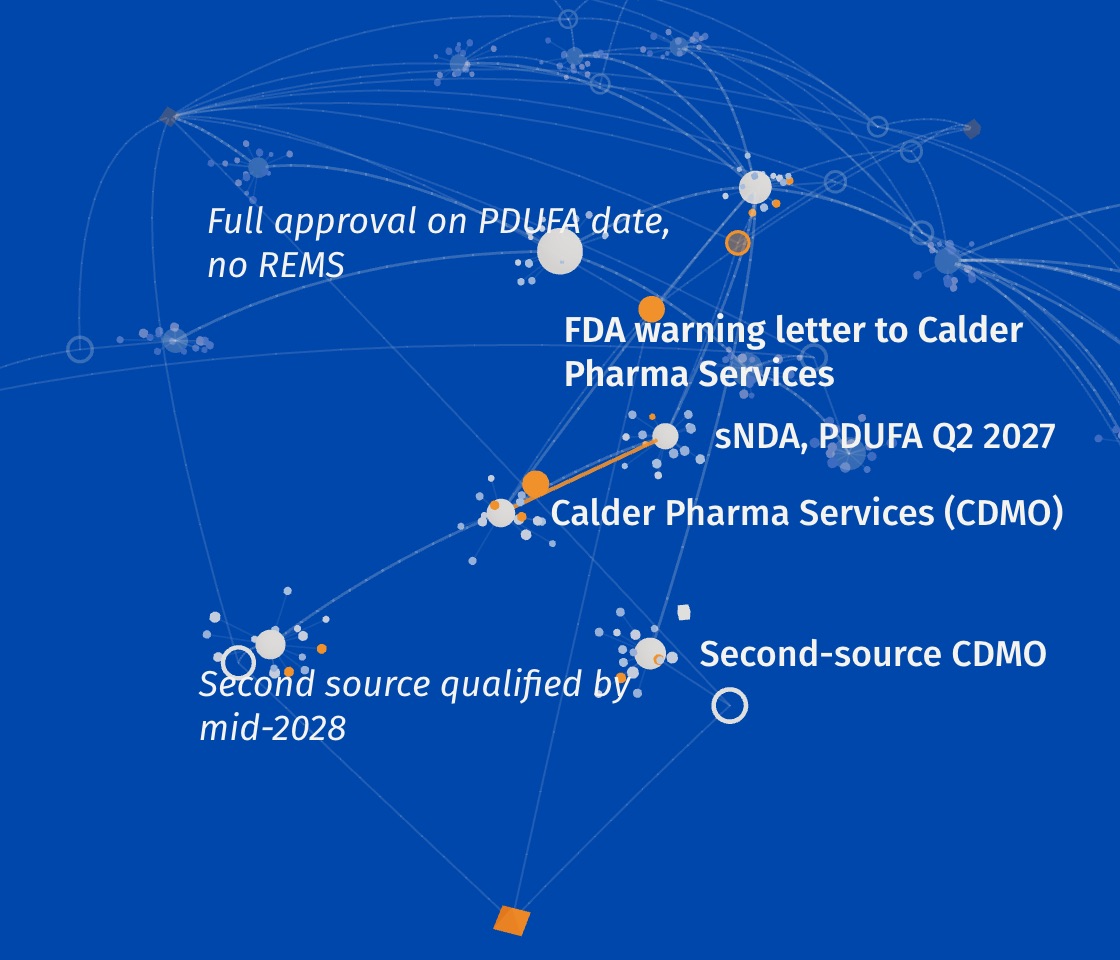
FDA inspection classifications, warning letters and import alerts at your CDMOs and API suppliers, and drug shortage listings in your category. Most of this runs on public FDA data.

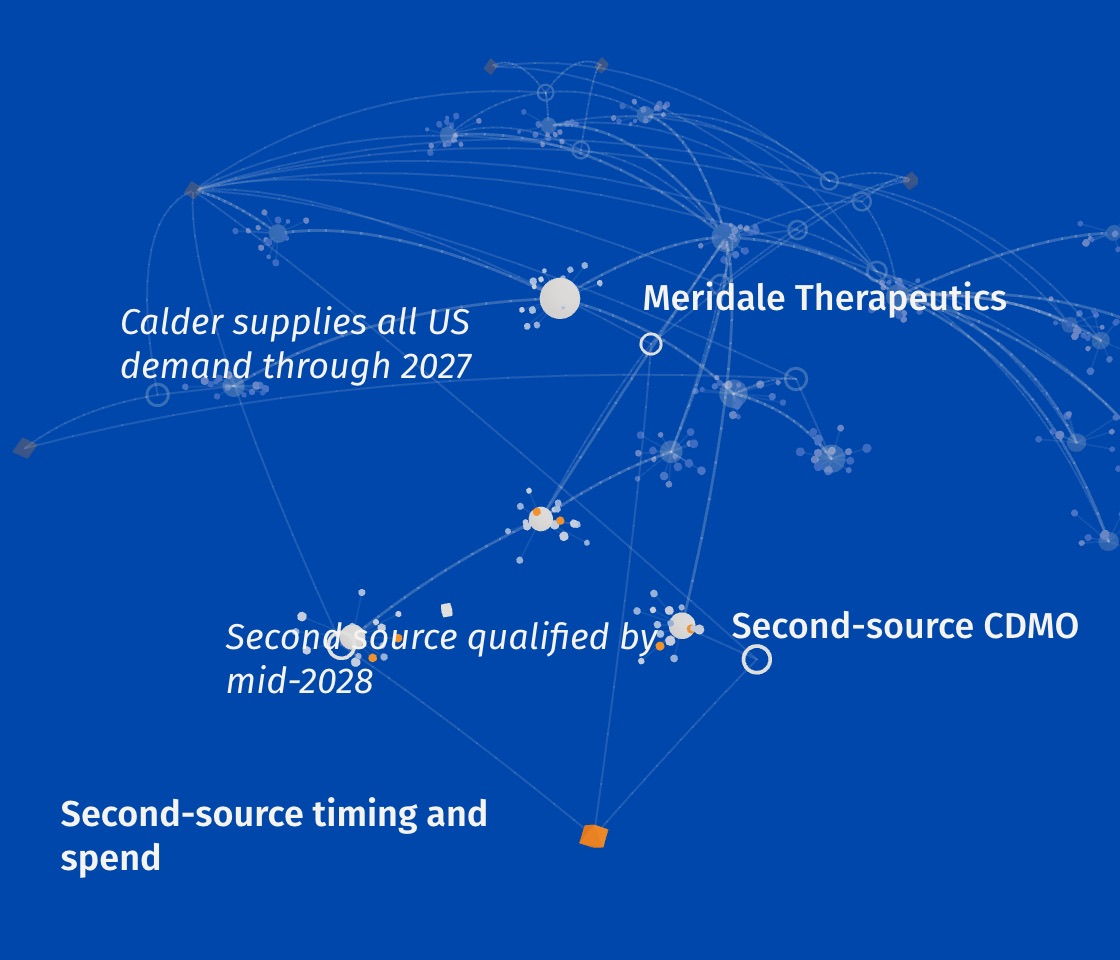
The part of Meridale's strategy graph behind the decision: Supply and manufacturing

Supply lens

  • Supply Resilience Watch, Watch agents

One example

  1. FDA posts a warning letter to Calder Pharma Services, the drug product site named in your sNDA
  2. Calder supplies all US demand through 2027Holding to At risk

    Full approval on PDUFA date, no REMSHolding to Watch

  3. What it means: Two assumptions and two decisions move; it is the worked example further down this page

What the agents read

  • FDA Inspection Classification Database
  • Warning letters, Form 483s, import alerts and recalls
  • FDA and ASHP drug shortage lists

What they produce

  • A site-by-site compliance record with the date each item was posted
  • A brief whenever a finding touches a site named in your filings

Competition and clinical data

Competitor readouts, label changes, PDUFA dates, trial registry amendments, congress abstracts, and how AI assistants describe your therapy against the alternatives.

The part of Meridale's strategy graph behind the decision: Competition and clinical data

Competitive lens

  • Competitor Registry and Catalyst Watch, Watch agents
  • Congress Readout Delta, Watch agents
  • Readout Scenario Book, Office agents
  • AI Drug Information Monitor, Watch agents

One example

  1. The FDA decision on Vertex's povetacicept is due November 30, 2026
  2. New entrants in 2026 and 2027 do not trigger step edits ahead of KelvaraWatch

  3. What it means: The access team has its responses to an approval or a delay drafted before the decision posts

What the agents read

  • ClinicalTrials.gov amendments
  • FDA approvals, label updates and PDUFA dates
  • Company filings, earnings calls and congress abstracts
  • What AI assistants say about therapies in your category

What they produce

  • A catalyst calendar for every competitor in your indication
  • A brief after each readout or label change
  • A quarterly audit of how AI assistants describe your therapy

Capital and partnering

Financing windows, comparable deals, in-licensing candidates, and the moves of partners and acquirers in your therapeutic area.

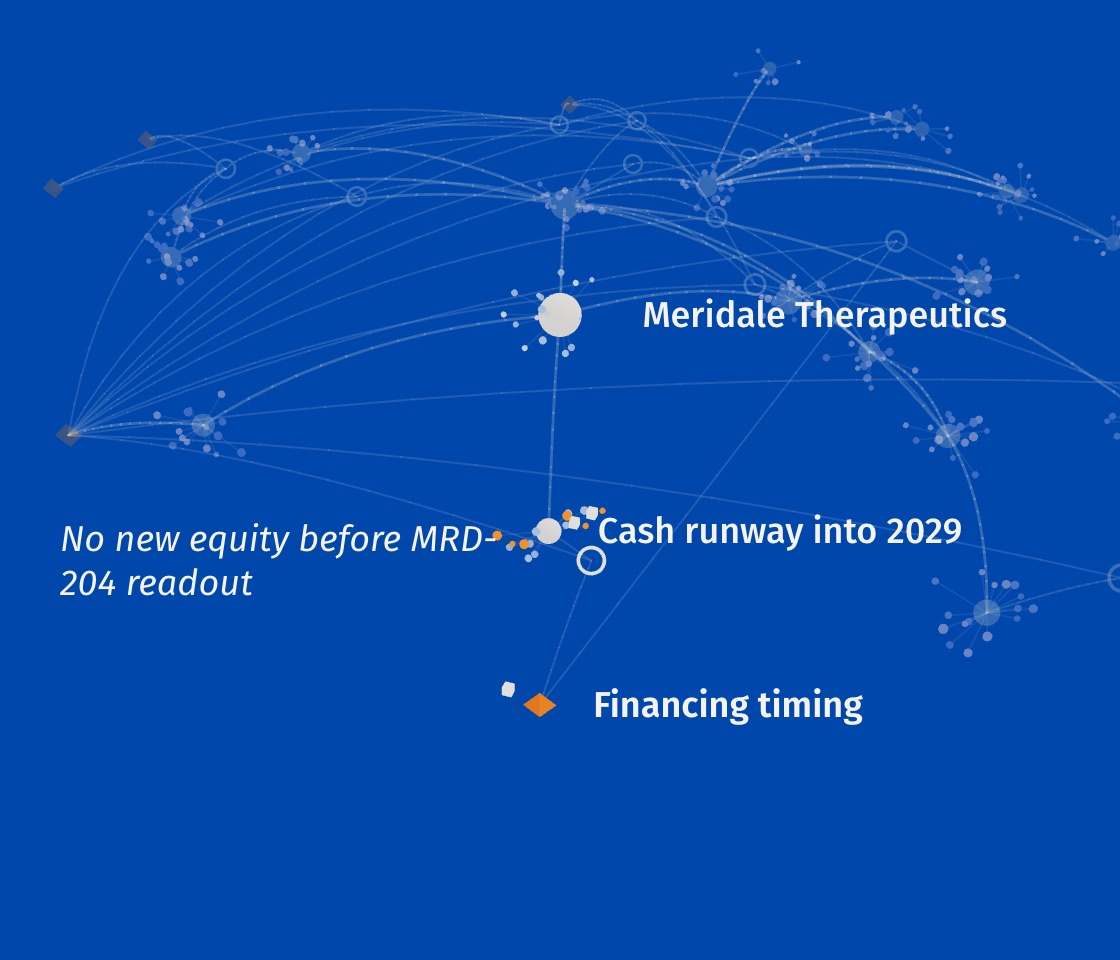
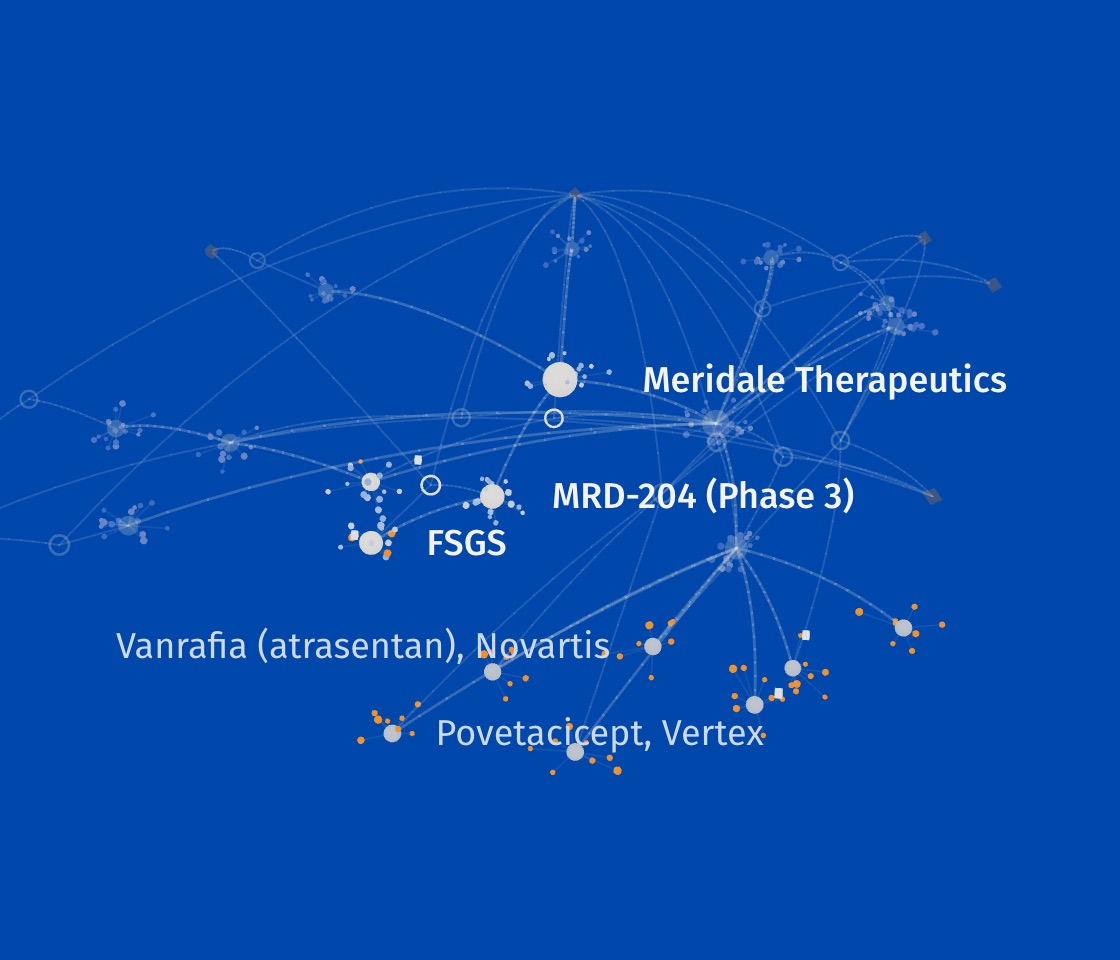
The part of Meridale's strategy graph behind the decision: Capital and partnering

Capital lens

  • Global Asset Scout and Diligence First Pass, Watch agents
  • Portfolio Value Refresh, Office agents
  • Market Research, Office agents

One example

  1. MRD-204 enrollment runs six weeks behind plan, which pushes topline data into Q1 2028
  2. MRD-204 topline Q4 2027 supports 2028 filingHolding to Watch

  3. What it means: The financing timing decision comes forward to the Q1 board meeting

What the agents read

  • Follow-on offerings and private placements in your therapeutic area
  • Licensing and M&A terms in filings and releases
  • Trial registrations from companies outside the US
  • The stated pipeline priorities of likely partners and acquirers

What they produce

  • A view of the financing window, with comparable raises and their pricing
  • A screened list of in-licensing candidates, each with a first diligence note
  • A portfolio value that refreshes when an input moves

Board and investors

The questions your board and analysts will ask, including the ones they have not thought of yet, and the pack that answers them.

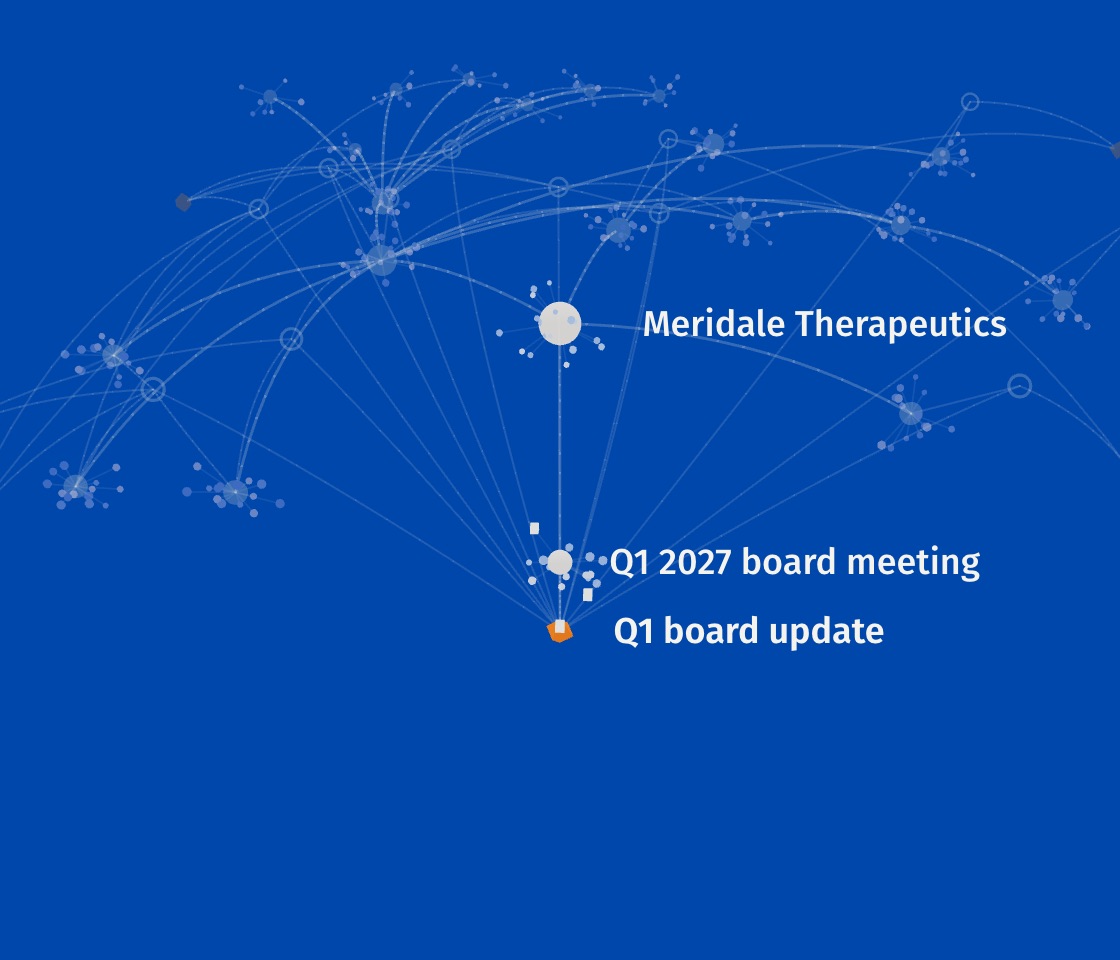
The part of Meridale's strategy graph behind the decision: Board and investors

Board lens

  • Board and Leadership Pack Builder, Office agents
  • Strategy Dashboard, Office agents
  • Strategic Planning, Office agents

One example

  1. The Q1 2027 board pack opens with the two assumptions that moved this quarter
  2. Calder supplies all US demand through 2027Holding to At risk

    Full approval on PDUFA date, no REMSHolding to Watch

  3. What it means: It leads with the question a director is most likely to ask: whether the field force expansion should wait

What the agents read

  • Everything the other five lenses produce
  • Analyst notes and consensus estimates
  • The questions asked on your earnings calls and your peers'
  • Proxy advisor commentary

What they produce

  • A board pack drafted with you each quarter
  • The questions directors and analysts are likely to ask, each with an answer and a source
  • The Decision Log entries behind every recommendation

One finding, start to finish

Every brief we send follows the same lens, so your leadership team knows where to look.

The FDA warning letter to Calder Pharma Services, linked to the supply assumptions and the second-source decision it affects.

Supply lens. Meridale Therapeutics. November 4, 2026.

A supply lens brief

FDA issued a warning letter to Calder Pharma Services after an inspection of the site that manufactures Kelvara tablets.

The letter cites inadequate investigation of out-of-specification results on a different product line. Calder has 15 working days to respond.

What happened.

FDA warning letter to Calder Pharma ServicesCalder Pharma Services (CDMO)

Which part of your plan it touches.

  1. Calder supplies all US demand through 2027At risk
  2. Full approval on the PDUFA date, with no REMSWatch

What else depends on it.

  1. Second-source timing and spend
  2. 2027 field force expansion
Kelvara reaches 4,200 patients on therapy by Dec 2027

Calder supplies all US demand through 2027 moves from holding to at risk. Full approval on the PDUFA date moves to watch, because Calder is named as the drug product site in the sNDA.

The second-source decision, and the January decision on field force expansion, which assumes uninterrupted supply and full approval. The 2027 patient target depends on both.

What it means.

Near-term supply is not affected: Calder is still operating, and API inventory holds. The larger exposure is the approval timeline. If FDA is not satisfied with Calder's remediation before the PDUFA date, approval can slip even when the clinical package is clean.

What you'll be asked.

  • Directors will ask whether the January field force decision should wait, and what a slip in the PDUFA date would do to the 2027 patient target.
  • If the letter becomes public, analysts will ask who else makes Kelvara.

Options.

  1. Pull second-source qualification forward from mid-2028 to Q4 2027.
  2. Raise finished-goods safety stock to six months.
  3. Ask Calder for its response and remediation plan within two weeks, and prepare the regulatory team for FDA questions during review.
  4. Prepare disclosure language in case the letter becomes material.

Our recommendation.

Ask Calder for its plan now, and pull the second source forward if the plan does not commit to a remediation timeline before the PDUFA date. Hold the field force expansion at its current scope until Calder responds: a two-week delay, not a cancellation.

Sources. FDA warning letter to Calder Pharma Services, posted November 3, 2026, retrieved November 3, 2026. FDA Inspection Classification Database, Calder site, retrieved November 3, 2026. sNDA manufacturing section, version 3. 2027 operating plan, supply assumptions.

What reaches you

The brief is one of three things your leadership team sees. The other two stay current every week.

Assumption Watch

An Assumption Watch excerpt

AssumptionStatusChangedWhy
Calder supplies all US demand through 2027FDA warning letter to Calder; see supply lens briefAt riskNovember 3
Full approval on the PDUFA date, with no REMSCalder is the drug product site named in the sNDAWatchNovember 3
Parity coverage with Filspari and Vanrafia at PBM A and B through 2027PBM A 2027 formulary posted; Kelvara's tier unchangedHoldingOctober 28
New entrants do not trigger step edits ahead of KelvaraFDA decision on Vertex's povetacicept due November 30, 2026WatchSeptember 30
API inventory covers 18 months of demandConfirmed at the October supply reviewHoldingOctober 21

Decision Log

A Decision Log entry

2027 field force expansion.

Held at current scope, November 4, 2026.

Decided by the CEO with the COO and chief commercial officer.

Revisit when Calder's remediation plan arrives, or on November 24, 2026, whichever comes first.

The expansion assumed uninterrupted supply and full approval on the PDUFA date, and both moved this week.

Relies on:

  • the 2027 patient target
  • parity coverage
  • full approval on the PDUFA date
  • Calder supply

Your dashboard

The same model, as your CEO, COO and board see it, updated as your market moves.

Meridale Therapeutics decisions exposed, November 4, 2026

3 decisions need attention2 assumptions moved this week1 at risk

What moved this week

  • Calder supplies all US demand through 2027: Holding to At risk. FDA warning letter to Calder; see supply lens brief.Touches 2027 field force expansion; Second-source timing and spend. Source: FDA warning letter to Calder Pharma Services, posted November 3, 2026, retrieved November 3, 2026
  • Full approval on PDUFA date, no REMS: Holding to Watch. Calder is the drug product site named in the sNDA.Touches 2027 field force expansion. Source: sNDA manufacturing section, version 3
Open the supply lens brief

Why two of us, and not a firm

The big strategy firms can bill a mid-size company millions of dollars a year in project fees. The partner who sold the work shows up for the steering committee. The analysis is done by associates a few years out of school. And when the project ends, everything the team learned about your business leaves with it.

Coactivator costs about what you would pay one senior strategy hire. For that, two ex-BCG and Accenture strategy consultants who have also run healthcare businesses work on every piece of your strategy, with AI agents reading your market every day against your plan. Nothing waits for a statement of work, and nothing ends when a deck is delivered.

A big strategy firmCoactivator
Who does the workA partner sells it; analysts and associates deliver itThe two of us, on every piece of work
When it happensA project, with a start date and an end dateContinuously, often before you ask
What it knows about youWhat each new team learns in its first weeksYour strategy model, kept current from week one
What it costsProject fees that can reach millions a yearAbout the cost of one senior strategy hire

On call, not on a calendar. When something material happens in your market, you hear from us that day, with what it puts at risk and what we would do first. And most of the work starts before anyone asks. We know your plan and the calendar it runs on, so the scenarios are drafted before the readout, the rate notice or the board meeting.

Illustrative: ahead of a competitor decision at Meridale Therapeutics

  1. 6 weeks out

    The Competitor Registry and Catalyst Watch puts the FDA decision on Vertex's povetacicept against the step-edit assumption in the plan.

  2. 4 weeks out

    The Readout Scenario Book drafts the access team's response to an approval and to a delay.

  3. 2 weeks out

    We take the COO and the head of access through both, with the questions the board will ask either way.

  4. Decision day

    Whichever way it goes, the response is ready and the Assumption Watch moves that day.

How it starts. In the first two weeks we build your strategy model from your plans, board materials, forecasts and operating reviews, and set up the agents around it. Alongside, we learn how your leadership team decides. By the end of the first month the work arrives in your formats, and you have two partners on call. Engagements run for at least six months.

Who we are

Sanjay Cherian

Sanjay spent a decade at Accenture as a strategy consultant specializing in health and life sciences, advising pharmaceutical companies including Merck, Pfizer and AstraZeneca. His work there covered market entry strategy, product launches, and the econometric and portfolio analysis that tells a commercial team where its next marketing dollar earns the most. He then took operating roles: he led digital innovation for retail pharmacy at Shoppers Drug Mart across roughly 2,000 stores, built North America's first two-sided digital health marketplace as Chief Product Officer at Telus Health, and was Global Head of Generative AI and Enterprise Data at Nike. He founded Tenuto Labs, which builds the ontology-driven AI systems Coactivator runs on. Based in Austin.

Hans Oh

Hans has spent more than two decades advising and running healthcare and life sciences businesses. He began inside a large hospital system, reporting to its COO on process re-engineering and cost analysis. As a strategy consultant at Accenture and then BCG, where he was a Digital Health Expert and Team Lead, he advised pharma companies, providers and payers. He led a five-year benchmarking study of IT spending across 16 major biopharma companies, and worked on a provider cost-reduction program that delivered $18 million in net savings within two years. He then took operating roles as a vice president at ZappRx and Omnicell. At ZappRx he negotiated the company's first biopharma commercial agreement, which became the template for three more, and led the deal effort for its sale to Allscripts. He founded Innoveron Group, a healthcare strategy consultancy, and co-founded Tenuto Labs. Based in New York.

Tell us what's in front of you

Write to us with the decision you're facing, a competitor event coming up, or the plan you're working to. Within 48 hours we'll send you a short brief built from public sources, so you can judge the work before we talk.

coactivatorai@tenutolabs.com

Some starting points:

  • A decision you're facing: a two-page decision brief.

  • A competitor readout or PDUFA date coming up: an event brief before it lands, and a follow-up after.

  • Your plan: a first Assumption Watch for your company, built from public filings and federal data.